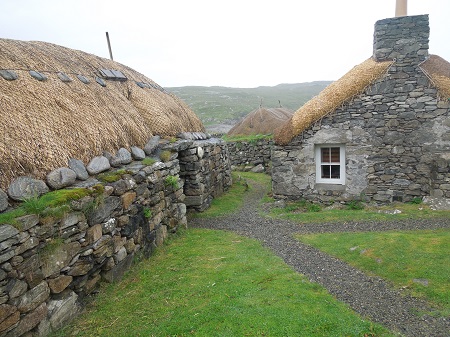
This is a continuation of our tour of Isle of Lewis, Scotland. Last week I covered Dun Carloway Broch and the week before Callanish Standing Stones. Rain was still sprinkling when we arrived at Gearrannan Blackhouse Village but it didn't deter us from jumping off the bus and heading to the museum. As you can see, there are several cottages here. One is a gift shop and also where you buy tickets. One has been restored to the way it was when people lived here. One is set up with a video with historical information and beautiful signs telling a lot of information and showing photos of the village and those who lived in it in the past.

Blackhouses were built with double wall, dry-stacked stone
and the space in between the walls was filled with packed earth. The houses have wooden rafters
covered with turf and thatched with straw or reed. The floors were usually
either flagstones or packed earth. Centuries ago, they didn't have chimneys.
Instead, the fire was built in the center of the room and the smoke escaped
through a hole left in the roof. The house had two sections, one for the people
and a lower part for the livestock, like cows and sheep. This kept the animals
warm during the harsh winters.
 |
| A peat fire. |
This peat fire was burning in the museum, which is a cottage just as it was when lived in in the early part of the 1900s.
 |
| The peat fire made the interior very smoky. |
A sign on the site reads: "The blackhouses were abandoned in
1974 when the last residents moved to Council Houses nearby. Being the last
surviving group of such houses in the islands, and having such an attractive
setting, their significance was recognized and the blackhouse village was
formally designated as an outstanding conservation area in November 1976.
Restoration began in 1991, and the main work was completed in 2001."
 |
| Click to enlarge. This shows the family tree of the family who lived in this cottage. |
Old looms for weaving. Harris Tweed is a big industry here.
 |
| A bucket of dry peat to burn. |
Experts have found evidence of a settlement on this site two
thousand years ago, but it was abandoned. In the 1500s another village was
established. Records from the 1700s show that one extended family lived here. Most of those who lived here later, into the 1970s, were descended from one
MacLeod family.
The plaque reads, in both Gaelic and English: "This stone commemorates the official opening of The
Gearrannan Blackhouse Village by HRH The Princess Royal 5th June
2001"
An 1850 Ordnance Survey map shows that at that time, the
houses were not where the current houses are. Instead they were a few yards to
the south and the village was called Sithean. The land was farmed communally.
After 1850, separate crofts (plots of farming land) were established for each
family. In 1886, the Crofting Act went into effect and this improved conditions
for the tenants. They didn't have to worry about eviction and they were then
allowed to pass their land on to their families. The present blackhouses
(further north than the older ones) and the crofts that go along with them were
established at the end of the 1800s.
When the potato crop failed between 1845 and 1850, many
people emigrated from Isle of Lewis. The Factor of the Lewis Estate at the
time, J. Munro MacKenzie, recommended emigration to two of the Gearrannan
families who could not pay their rents. This information is from his diary.
The local economy improved in the late 1800s and some of the
men from the village found work in the ling-fishing industry at the nearby
Dunan pier at Carloway. Three men from the village skippered boats. Others from
the village went into the military, which provided some income, while some wove
tweed on wooden looms. In 1908, those over age 70 could draw a state pension.
In 1891 the population of the village was 109. This number kept increasing to
around 1910. In 1904, 84 of the students at Carloway School were from
Gearrannan.
As you can probably tell because of my hood, it was still raining, even toward the end of the stop at this site. The midges were also really bad, especially on this hillside. For those who don't know, midges are like mean gnats. They happen to love my husband. They were getting inside his hood, biting his face and neck and dive-bombing his eyes. They got so bad, he returned to the bus early to escape them.
In 1891, 20 of the 165 people who lived in Gearrannan were
fishermen, according to the census. The ling fish were caught on baited long
lines, then salted and dried before being exported. This fishing industry was
in successful operation until the outbreak of WWI. After the war, the old boats
were in bad condition and the market for the fish had dried up.

There was an economic depression here after the war. What
little work that could be found included seasonal employment in herring fishing
crews, although it was not as popular or successful as it had been previously.
Crofting provided the basic foods for the villagers. Gearrannan was always
first to plant crops in spring and every piece of arable land was cultivated.
They also grazed sheep and cattle. But the crofts couldn't support everyone and
many were without employment. In the early 1920s, hundreds of islanders left
for America and some went to the Scottish mainland for employment. In the 1930s
the local economy improved with the growing Harris Tweed Industry.
When the village grew too crowded, some families acquired
crofts three miles up the coast at Dalmore.
World War I took many of the villagers' lives, especially
when the naval yacht, Iolaire, sank while taking island servicemen home from the war in
the early hours of New Year's Day, 1919. A sign in the museum shows the photos
and names of each man who was from Gearrannan. This is known as the Iolaire Disaster and was devastating for the islands of Lewis and Harris because the islands had already lost over a thousand men during the war. Tragically, 205 men died when the Iolaire crashed into rocks and sank twenty yards from shore. Forty men made it ashore.

People of the village had good overall health in the 1800s.
They worked hard, were physically fit and they ate a healthy diet of mostly
oatmeal, potatoes, fish and milk. Of course, some diseases at that time were
more prevalent than today, such as typhoid, infant tetanus and tuberculosis.
The nearest doctor was eight miles away, but most people went to the local
healer, John MacDonald (1829 – 1891.) He was skilled with blood-letting and
herbal cures.
 |
| A very cool bench. |
How would you like to stay in one of these blackhouses?
Well, you can. They are self-catering. These houses have
been restored. The exteriors look as they might have two centuries ago, but the
interiors offer all the modern comforts of home. The kitchens are modern and
they have controllable heat along with separate stoves for burning peat or
wood, electric showers, and nice bedrooms. This work was done by the Gearrannan
Trust a charitable trust of volunteers, most from the local area.
The ceilidh is an
evening of storytelling and music. Everyone participated and enjoyed these
events. Other forms of entertainment for daytime were shinty and football. In
June 1934, a traveling circus visited Gearrannan. The children of the area were
enthralled by the acrobats, jugglers and bare-back riders.
 |
| This ruin was on the hillside overlooking the village. It looks like it was once a cottage. |
In the 1950s many of the island men joined the Merchant
Navy. When they returned home on leave, they brought presents and told exciting
stories of their travels to distant lands, but they also missed their loved
ones while away. One of the most popular Gaelic love songs "Gruagach Dhonn Bhrunail" was
composed by a Gearrannan man named Donald John MacDonald on board the
"Urstom Grange" in the early 1950s.
In the 1950s and 60s most of the residents of the
blackhouses were elderly spinsters because the young people had moved away for
employment, marriage or education. The ladies who remained had lived lives of
hard work. They could still call on relatives in the local area, outside the
village, for help in thatching or other heavy labor when necessary. By this
time, there were very few blackhouses left anywhere in the islands. Tourism
increased as more people wanted to experience the special atmosphere of this
little village "at the edge of the world."
 |
| (Click to enlarge) |
The houses began to deteriorate and the residents needed new
places to live. In 1970, a site at the other end of the village was approved
for building twelve new houses. After these were built, in 1974, all the
remaining residents, four ladies and one gentleman moved to Gead Gorm. These
new houses required no thatching, water was piped in instead of carried by hand,
but the residents were allowed to have their cozy open peat fires.
Thanks!
Vonda

Gwyneth Carswell, an English lady banished by her father to the harsh Scottish Highlands, wants nothing more than to take her young son away from the violence of two fighting clans--her own distant kin, the MacIrwins, and their enemies, the MacGraths. She risks everything to rescue the fierce MacGrath warrior from the battlefield where he’s left for dead by her clan. She only knows she is inexplicably drawn to him and he wants peace as she does. When her clan learns of her betrayal, they seek vengeance. Dare she trust the enemy more than her own family?
Laird Alasdair MacGrath is driven to end two-hundred years of feuding with the MacIrwins. But by taking in and protecting Lady Gwyneth and her son, he provokes more attacks from his mortal enemy. As the danger and conflict surrounding them escalate, Alasdair and Gwyneth discover an explosive passion neither of them expected. With the arrival of a powerful man from her past, a horrible decision confronts her--give up her son or the man she loves.