Showing posts with label Duart Castle. Show all posts

Duart Castle, Isle of Mull, Scotland

Approaching Duart from the Sound of Mull
 Today's post is a continuation of our tour of Duart Castle on Isle of Mull in Scotland. In last week's post, I covered some of the history up to the 1400s. Photography was not allowed inside the castle, but I found some pics online for you to see. After clicking on the photo link, remember to click the back button to return here.

The kitchen was designed in 1912 during the reconstruction of the castle. The coal range here was used until 1960. There is a cook's kitchen table and a dry store through the doorway. The vegetables were prepared in the scullery, which is a separate room with two sinks.

The dungeons hold officers who were captured after their Spanish galleon showed up in Tobermory Bay in 1588. (No, they're not real officers. :))

Next we went up a turnpike stair which was built into one of the earliest walls of the castle. The pantry is at the top of the stairs. The food from the kitchen arrived here on a dumb waiter. China is also kept here.

The Sea Room was probably my favorite room because it has amazing views out over the Sound of Mull and Loch Linnhe. This room was added in 1912 to provide covered passage from the rooms on the north side of the courtyard into the keep. On a clear day, you can see Ben Nevis from here. The room contains many interesting artifacts, including a small Spanish cannon dredged up from the mud of Tobermory Bay, where the galleon from the Armada sank.

The Great Hall or banqueting hall is one of the most fascinating rooms because of all the history it contains. The wall here is ten to twenty-three feet thick, and where the keep joins the original courtyard wall on the west it is sixteen feet thick. The portraits here show Macleans spanning three hundred years. The coat of arms of the 26th chief is on the fireplace. We left the room via another turnpike stair built into the thickness of the wall. These types of stairs turn clockwise so that castle defenders could easily fight with their swords in their right hands.

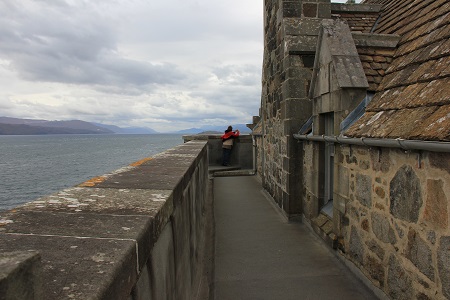
The Dressing Room and State Bedroom is on the next floor. The four-poster bed and matching furnishings were made for the wartime honeymoon of Lord Maclean and his bride. This floor also contains a large collections of family photographs from the mid-19th century to present day. Also on display are many examples of historical clothing from the Maclean family including a dress from 1750. On the top floor of the keep is a large display area that tells the history of the clan. The walls were removed between three bedrooms and a bathroom to create this exhibition area. Next we went onto the wall walk on the roof of the castle, which I showed you last time. After this we left the castle and passed through the courtyard again.

The Courtyard
 Hector Odhar Maclean of Duart was among the clan chiefs who fought with James IV at Flodden in 1513 against the English and were also killed with him. The MacLeans and Campbells were allies during this time and this tie was strengthened by marriage. But one disastrous and infamous incident destroyed this alliance. Lachlan Maclean of Duart married a Campbell's sister, Catherine (the daughter of the 2nd Earl of Argyll). One story says she tried to kill him twice and another story says she failed to produce an heir for him… in any case, he tied her to a rock in the sea at low tide and left her to drown once the tide came in. Fishermen passing in a boat saw her and rescued her, taking her back to her brother. Not knowing she had been rescued, Maclean reported her death to her brother. Revenge ensued. In 1523 Lachlan was 'dirked in bed' while in Edinburgh. One source says he was killed by Sir John Campbell of Calder. The rock where Catherine was tied is now known as The Lady Rock and can be seen from Duart at low tide.

The entry/ exit
 The Macleans were at their most powerful in the late 1500s, but the Campbells also held a lot of power within the Stuart Court. Since they were now enemies of the Macleans, the Campbells took every opportunity to humble the Macleans and Macdonalds. These clans were already weakened by the many years of clan warfare and by the deaths of their chiefs. James VI disapproved of Sir Lachlan Maclean's dealings with Elizabeth I and this led to the sequestration of Duart in 1604 to the King's Commissioners.

Four years later, Lord Ochiltree was sent to Mull by the king as viceroy in an attempt to further subdue the troublesome chiefs of the islands. He invited all the chiefs to a social get-together on board his ship at anchor. As they awaited the toast, he told them they were all under arrest. They were taken to Edinburgh and forced to agree to the terms of the Statutes of Iona under which they lost most of their sovereignty over the islands.

The Macleans were allowed to return to Duart. The next few years were peaceful for the Macleans and they enlarged the castle and made it more comfortable. Despite what King James VI had done, they remained loyal to the crown during the Cromwell era. The chief at the time, Sir Hector Ruadh Maclean was killed at Inverkeithing in 1651. Eight of his foster brothers were killed by Cromwell's troops as they fought to rescue their chief, and 750 clansmen died with them.


After leaving the castle, we had lunch at the Duart Castle Cafe. I enjoyed the parsnip soup and sandwich. Then we walked down toward the shore. The wind was becoming stronger by the moment. Because I was sick with a bad cold, I was bundled up like winter with my thick scarf and several layers of jackets and a rain coat.


Heather


 In 1653 five naval ships were sent by Cromwell to capture the 10 year old chief. Three of these ships sank during a massive storm just below the castle, and one, The Swan, is still being investigated and analyzed by academics. It is still under the water.


 After the Civil War, the Macleans found themselves deeply in debt because they'd mortgaged most of their lands to fight for the king. The Campbells bought up these debts and eventually owned most of the Maclean's lands. The chief at the time was a child and his tutor gathered a small army, trying to fight the force of the Earl of Argyll. But the earl obtained letters of Fire and Sword in 1674 and launched into a full scale assault. After much fighting, the Macleans had to surrender the island.

In 1681, the land was returned to them when the Earl of Argyll fell from grace. But in 1688, Argyll was back in favor and Duart was once again besieged from the sea by English warships. The chief, Sir John Maclean was, at that time, fighting with his clan at Killiecrankie for the Jacobites. But they were defeated and this enabled the Campbells to return to Mull. With a force of 2500 men, the Campbells destroyed Duart Castle. The chief held out with the Jacobites on the Treshnish Islands, but they were finally defeated in 1691. The Maclean estates were forfeited. The castle, though mostly ruined, still held a government garrison until 1751. After this the castle was abandoned and became in worse condition.


 The Macleans would not hold Duart for the next 160 years but they remained strong in the military and the many of them lived on the island of Inchkenneth.

Colonel Sir Fitzroy Maclean, Bt.,KCB, Twenty-sixth Chief of Clan Maclean bought back the ruined Duart Castle and a portion of the peninsula around it in 1911. He hired the Scottish architect Sir John Burnet to restore the castle and make it a comfortable place to live.

Underneath the castle
 As you can tell, the sky is getting darker and there are some raindrops on my lens, causing blurs. The wind was also blowing harsher. But I thought it was the neatest thing to walk around underneath the castle where it sat on that cliff.


 We talked to the current chief, Sir Lachlan Maclean, although we didn't know who he was until later. He has two adorable dogs. He works on the mainland but spends a lot of time at Duart. In 2000 he planted the Millennium Wood, a collection of trees and shrubs indigenous to Argyll. He has also had extensive work done on the castle.

Even though it was a few minutes until the bus would leave, we hurried back because of the worsening weather. I took this picture of Duart through the bus window. We were glad we returned to the bus early when the driver left before the scheduled time. It might not be such a bad thing to be stranded on Isle of Mull for one night, but I wasn't sure the chief would let us stay at the castle. :)

Hope you enjoyed this tour of Duart Castle!
Thanks!
Vonda

P.S. I got a great new review from Night Owl Reviews
4.50 / 5 - Reviewer Top Pick

 My Daring Highlander is historical romance at its best. Ms. Sinclair gives us another magical story in her Highland Adventure series. My Daring Highlander brings Scotland to life and sweeps you into a world where love isn't always enough but maybe hope is.
Keegan and Seona face almost insurmountable odds. They do so with dignity and honor. The attraction between them simmers until it explodes. Their love story is truly an amazing one and I was so caught up in their lives that I read this book in one sitting. I love this series and I love the characters. I wish I could think of a sexier description for them but what the couples are in these books are grown-ups. They face their lives with courage and truth.  Start at the beginning with this fantastic series. The author weaves a spell-binding tale of love, honor, family and friendship.
--
Keegan MacKay loves Seona Murray but can never have her. She is above his station and will be given to another. Seona is entranced by the man she's come to know. When he escorts her back home their passion explodes, even as danger tracks them.

A Trip to Duart Castle

On the Ferry

The day we visited Isle of Mull and Duart Castle was cloudy and windy. Based on the forecast, we knew the weather would only get worse, so this was our last chance to visit the island. Sure enough, the next day no ferries were running out to the islands at all because of insane winds. We parked in Oban and bought a ticket which included the ferry, bus, and castle tours all in one.


beautiful views from the ferry
I was also very sick by this time. I'd caught a cold soon after arriving in Scotland, but I was determined to not let it stop me. The ferry ride was nice with great views. You can stay outside or go inside where it's warm and have a snack or coffee. The ferry also has a gift shop, restaurant, lounge, and several other things. I sent my husband out to take pictures. :) He took these first three.

You can tell by this picture how cold it was. Everyone was dressed like winter even though it was September.

Lismore Lighthouse in the Sound of Mull


Click on the above photo to enlarge it and get a good view of the Sound of Mull. I did have to bundle up and venture outside to take some pics myself. I took several of Duart Castle as we passed by. Little did I know at the time that we would explore Duart from the ramparts to the grassy area near the shore.

Duart Castle
Duart Castle stands prominently on a cliff that overlooks the Sound of Mull. This has been the base of the Clan Maclean for over 600 years.

Approaching Duart Castle from the parking area.
Once we disembarked at Craignure on Isle of Mull we found the bus for the Duart Castle tour waiting for us. Part of the way, the road was one lane. It took ten to fifteen minutes to get to the castle.


The Courtyard.
We entered the courtyard and I thought the interior and buildings were beautiful. This castle was restored in the early 1900s, but these buildings look incredibly authentic for hundreds of years ago. The rowan tree here (above) was planted on Sir Fitzroy Maclean's 100th birthday. It's believed to ward off evil.

The Courtyard, opposite direction.
 The castle was restored between 1911 and 1914 by Colonel Sir Fitzroy Maclean, Bt., KCB, Twenty-sixth Chief of Clan Maclean. Before that, the castle lay in ruins.

Click photo to enlarge sign.
Information from other signs posted here:

"About 1150 Duart was just a courtyard. No grass then, only mud and rocks and simple wooden shacks for shelter. You would have had no shoes or socks, even in winter; long hair, no brushes or combs and your clothes would be a simple strip of woolen cloth to keep you warm."

"The Keep, which is another name for a Tower House, is where everyone lived. This one was built by Lachlan Lubanach, the 5th Chief, in 1360. The main entrance was up a short flight of stairs from the courtyard."


Next, we went by the kitchen and dungeon. Sorry, no photos were allowed of the interior. The ground floor of the castle was originally one vaulted room with two small windows.

View out one of the windows.
Experts believe a castle existed on this site long before the first walls of Duart were constructed in the mid-1200s because it is such a strategic position on a high cliff on the end of a peninsula which juts into the Sound of Mull. Duart comes from the Gaelic Dubh Ard, meaning 'Black Point'. This location allowed the Macleans to control the Sound of Mull, which runs between Mull and the mainland of Scotland, and also the entrances to Loch Linne and Loch Etive and also part of the Firth of Lorn. This site would've been of vital importance during Viking and Norse invasions. Later, the Lord of the Isles ruled this area and the Macleans were supporters. There were eight castles on each side of the Sound of Mull which could communicate with one another via a beacon.

Click the above photo to enlarge
Maclean means 'Son of Gillean.' Gillean of the Battle-Axe (Gilleathain na Tuaidh) was a warrior who lived in the 1200s. He is known to have been alive in 1263. One of his ancestors was Lorn, the brother of Fergus Mor MacErc, founder of the Dalriadic kingdom which centered in Argyll. Gilleathain fought at the Battle of Largs and his son Gillenmore is mentioned in the Ragman Roll of 1296. The Macleans supported Bruce at Bannockburn. After that, they settled on Isle of Mull and came into conflict with the MacKinnons who already lived here.


Macleans were recorded in the papal dispensation of 1367 which allowed their chief, Lachlan Lubanach (the crafty or cunning) Maclean to marry the daughter of the Lord of the Isles, Mary Macdonald. It is said this was a love match, but her father wouldn't allow her to marry Maclean until he had kidnapped her. Another account says Lachlan kidnapped the Lord of the Isles in order to marry his daughter. The Mackinnon Chief was killed during this incident, and since Macdonald was Lord of the Isles, he gave the Mackinnon land to Maclean as part of his daughter's dowry. It is said he approved of Lachlan as a husband for his daughter because of his daring during the kidnapping. This is how the Macleans ended up owning most of Mull.

Click the above photo to enlarge and see the great view from the wall walk or battlements.
Lachlan Lubanach Maclean is believed to have built the keep at Duart. The first mention of Duart was 1390. But the great curtain walls already existed from the previous century. On the more vulnerable landward side, the walls are 29 feet high and almost 10 feet thick. A ditch was cut through the rock beyond the wall for further defense. The walls facing the sea were not as thick, 5 – 8 feet.

The wall walk
Lachlan Lubanach's son was Red Hector of the Battles. He was a famous Maclean warrior who fought at the Battle of Harlaw on July 24, 1411. I mentioned him in my post on Drum Castle. Sir Alexander Irvine of Drum and Red Hector MacLean engaged in a one on one personal battle to the death. Yes, both men died. I wonder what they had against each other? Afterward, their families exchanged swords when their chiefs met.

The roof.
Hope you enjoyed the photos and info. I'll continue the tour of Duart next time.
Thanks!!
Vonda

Battle-hardened warrior Dirk MacLerie isn't who everyone thinks he is. He's Dirk MacKay, heir apparent to the MacKay chiefdom and Dunnakeil Castle on the far north coast of Scotland. When he returns home after a long absence, will his clan know him and will the duplicitous enemy who tried to murder him twelve years ago kill him in truth this time?

Lady Isobel MacKenzie is a beautiful young widow betrothed to yet another Highland chief by her brother's order. But when her future brother-in-law accosts her and threatens to kill her, she is forced to flee into a Highland snowstorm. When she runs into a rugged and imposing man she thought dead, she wonders if he will turn her over to her enemy or take her to safety.

Dirk remembers the enchanting, dark-eyed Isobel from when he was a lad, but now she is bound to another man by legal contract—an important detail she would prefer to forget. She wishes to choose her own husband and has her sights set on Dirk. But he would never steal another man's bride… would he? The tantalizing lady fires up his passions, testing his willpower and honor at every turn, even as some of his own treacherous clansmen plot his downfall.